
What If Workplace Problems Aren’t People Problems?
As leaders, we work hard.
We fight fires daily, yet the faster we solve problems, the faster new ones seem to appear.
We encourage people to speak up, yet getting candid feedback feels like pulling teeth.
We encourage collaboration, yet know that people have to compete for recognition, resources, and advancement.
We try new leadership approaches, but those rarely stick.
What’s going on?
The Workplace & Mindset We’ve Inherited
Most organizations are shaped by assumptions inherited from the Industrial Revolution. They’re based on narrow success measures, power-over hierarchies, rewards and punishments based on labeling people, and most importantly, the underlying view that people are replaceable inputs.
These conditions activate our survival mode. They put us on the defensive, making us more likely to react habitually as we protect our status and jobs, devoting whatever’s left to the mission at hand. Let’s call this inherited workplace architecture the Magnificent Compression Machine:
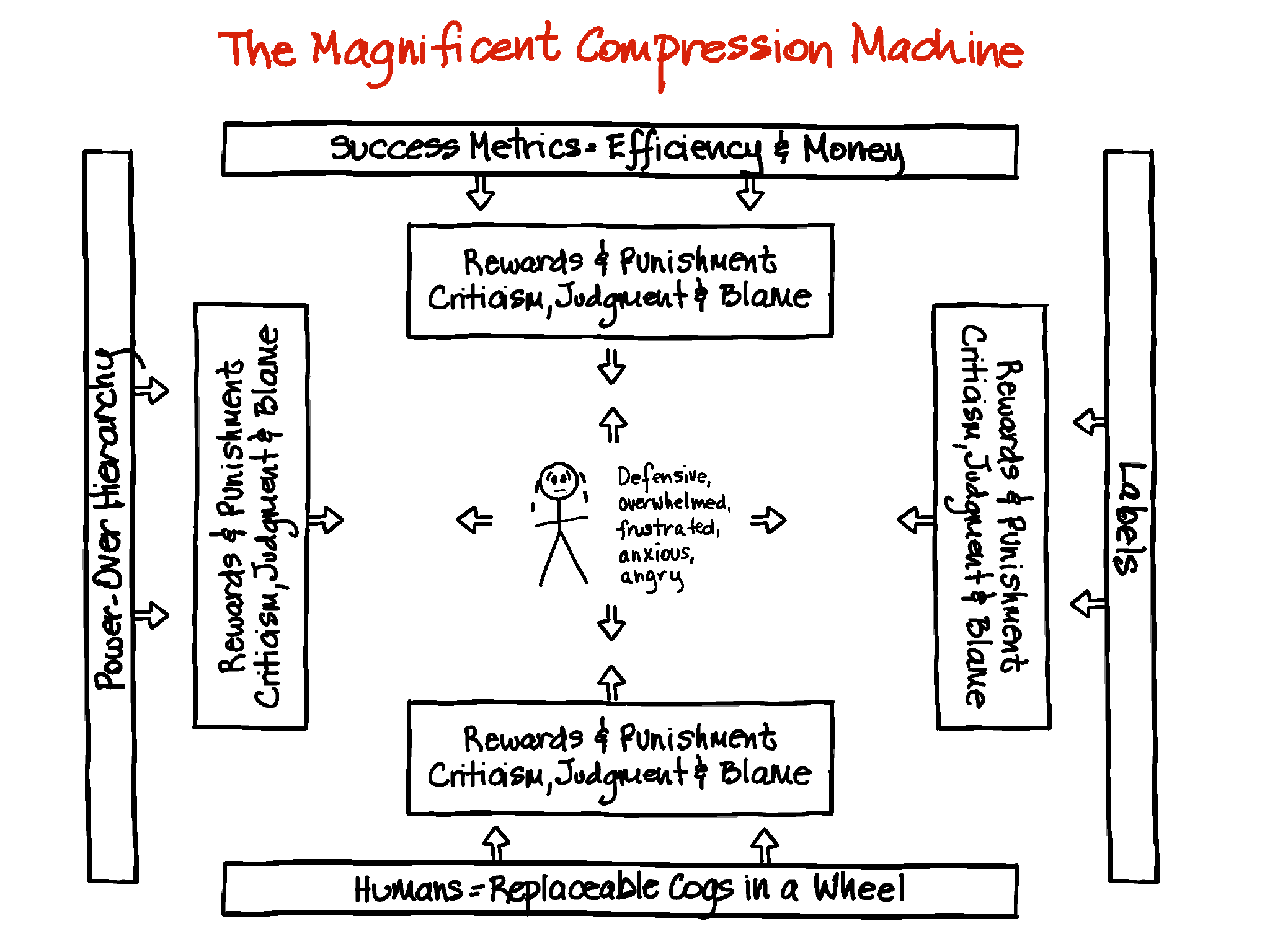
You’ve likely witnessed or experienced the distress of such an environment, where maximizing efficiency and money comes at the expense of values such as safety, honesty, and creative collaboration. You’ve likely seen decisions that affect you made without your input, watched people labeled by their habits or mistakes, or worried that one misstep could change how others see you. We may never call people replaceable resources, yet reducing them to headcount, expecting them to absorb ever-increasing workloads, or assuming someone can be replaced without ripple effects sends much the same message. You’ve likely worked faster and longer, making it harder to turn off long enough to rest or rejuvenate. It’s as if work has become a lifelong stream of proving one’s worth without even knowing if it will be enough.
And as people adapt to these pressures, we often see their resulting behavior as problems. Staff are defensive. They’re not performing as expected. They’re resisting change. We start thinking, “If only s/he didn’t act this way or hadn’t done this or that, we’d be OK.” We start to equate people with their behavior. We see them as problems to be fixed, without considering how the work conditions are influencing their behavior.
It’s the Context, Not the People
Systems thinking and decades of behavioral research show that humans are a mix of nature and nurture: our behavior can’t be separated from the environments around us or our internal mindsets. When we fear being laid off or humiliated, we’re more likely to defend our work, play it safe, or hide mistakes. When we feel respected and trusted, we’re more likely to speak candidly, experiment, and collaborate. We’re the same people, but we behave very differently in different situations.
Then why do we continue acting as though people need to be fixed?
Because we’ve inherited the assumption that people are their behavior, which has become a subconscious habit that often goes unquestioned. Contextual influences barely enter the equation. When we deem outcomes problematic, we look for who’s responsible. Who failed? Who cut corners? Who didn’t do as expected? What we call accountability can quickly become fault-finding, with the person’s character or capabilities put on trial. Usually, the remedy is punishment or replacement.
In essence, we put people into workplace pressure cookers, turn up the heat until they’re reacting from distress, and then blame them when they don’t perform at their highest capacity.
From Fixing People to Cultivating Engaging Workplaces
Imagine workplaces where we’re seen as creators rather than replaceable cogs in a wheel. We feel free to speak candidly, share ideas, take risks, and respond deliberately to mistakes with learning rather than criticism, judgment, and blame.
We become less like micromanagers and more like curators of the contexts we work in.
The antidote to the Magnificent Compression Machine?
The Magnificent Inspiration Society:
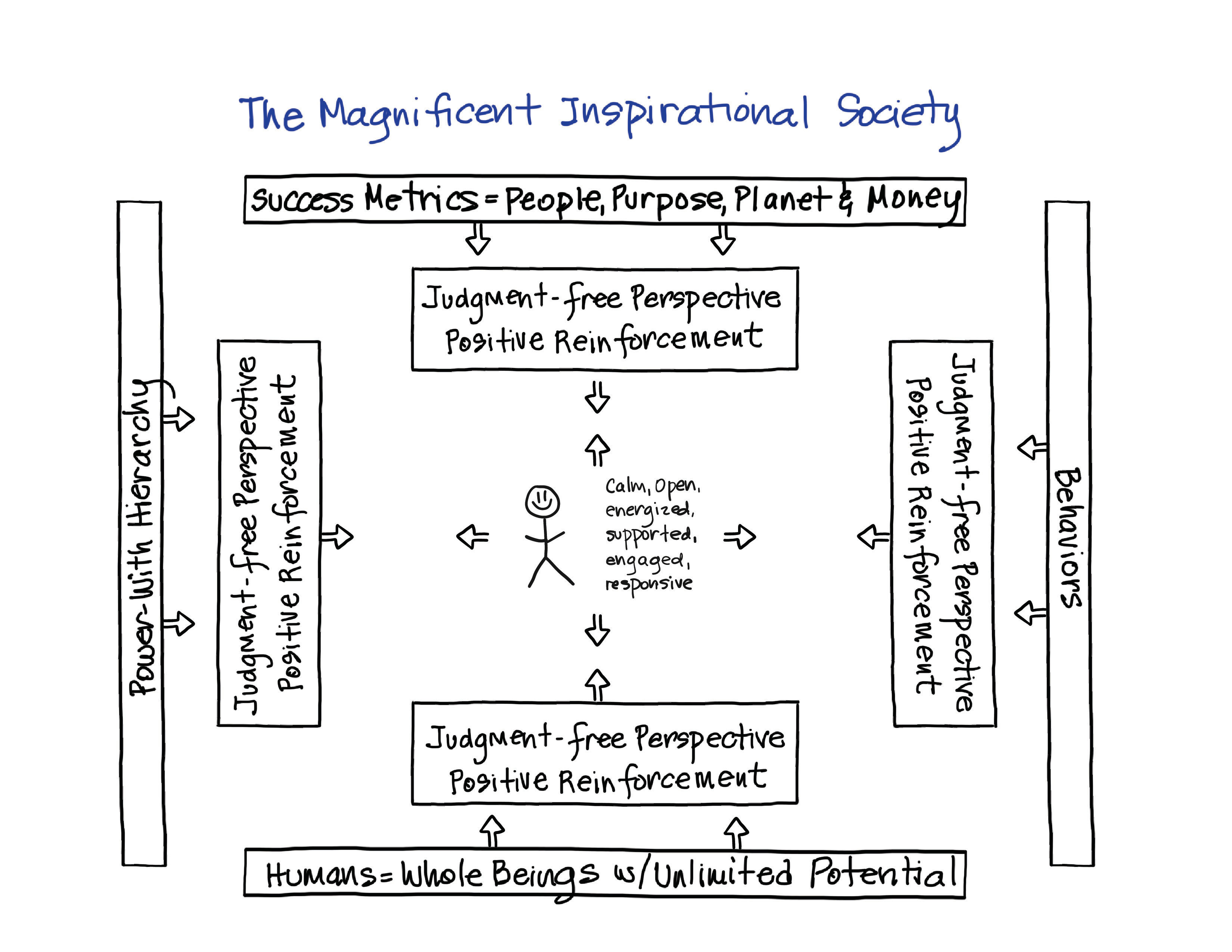
The Magnificent Inspiration Society broadens how we define success to include people, purpose, harmony with the planet, and money. Using power-with hierarchies, we recognize that people are equally valuable to the organization’s mission, even across differing roles and responsibilities.
Instead of labeling people as “smart,” “incompetent,” “difficult,” or “high performers,” we separate the person from their behavior, reinforcing what works and addressing what doesn’t. We stay neutral, using judgment-free awareness. And we treat people as creators with inherent value and enormous capacity to learn, contribute, grow, and adapt ingeniously to changing times.
These beliefs and rules of behavior also activate new mindsets. It becomes easier to lower our guards, feel calmer and more neutral, think about the context, and intentionally redirect capacity otherwise spent on self-protection toward the team and its mission. As leaders, we have a north star: the kind of environment we want to cultivate. Using the Magnificent Inspiration Society makes it easier to choose our next steps to move our teams toward greater thriving.
In essence, we design workplaces where we can flourish. In response, we can handle the high heat that comes from increasing disruption and uncertainty with greater resilience and insight.
Unlearning What We’ve Inherited
Seeing the workplace differently is one thing. Working differently inside the very structures we’ve inherited is another.
Take Alex.
He played a senior role in a global services firm that fit the Magnificent Compression Machine to a T. He had risen through the ranks from junior accountant to head of global operations, experiencing countless reorganizations during his 20 years with the firm.
Through all that change, he tried various ways to cultivate a sense of camaraderie within his team. When they didn’t respond, he was perplexed.
For instance, he asked staff to bring up mistakes as soon as they became aware of them, regardless of who made them. Catching mistakes early could prevent hours spent reassuring irate clients who discovered errors and readily spread the word, even though the team’s work was usually accurate.
When prompted by the Magnificent Compression Machine, Alex immediately recognized his workplace. He was amazed that just five underlying beliefs and behaviors could create and recreate so much organizational havoc.
Then he considered his team through the Magnificent Inspiration Society and immediately saw what he’d missed. He’d asked people to discuss mistakes, but hadn’t made it safe to do so.
Instead of blaming the person who made the mistake or automatically accepting blame from outside the team, they agreed to examine what contributed to errors and what could be done to prevent recurrences. Their discussions created a new freedom to speak up about errors without fear of criticism, judgment, and blame (CJB). That also led to new processes and cross-checks that supported their work through intense tax seasons.
Alex didn’t need another leadership technique. He needed a way to see what was happening beneath the surface and make it safe enough for people to expose rather than hide mistakes.
That wasn’t always easy because most people grow up fearing the consequences of mistakes. But once he stopped asking, “Why won’t they speak up?” and started asking, “What about the way we work makes speaking up difficult here?” new possibilities became visible.
Learning to see and work this way is where Human-Centric Leading comes in.
Human-Centric Leading (HCL) provides a practical way to systematically unlearn the inherited mindsets and structures that constrain human capacity in our workplaces. In doing so, we can shift from reacting habitually to responding deliberately in ways that align our intentions and goals, amplifying our impact. Its five tools give us a way to practice that unlearning to foster more open and trusting workplaces through everyday interactions: Context, Mindsets, Needs, Wisdom, and Emotions.
When we can change the workplace context, we can do so. When we can’t, or believe we can’t, we can change the ways we respond to its unwanted influences instead.
In other words, we don’t have to wait for someone else to act, more title power, or organization-wide change. We can start building the Magnificent Inspiration Society within our own sphere of influence, creating immediate wins that lay the foundation for team transformation even within a larger organization that still reflects the Magnificent Compression Machine.
Try It on Monday Morning
The next time you encounter an action that frustrates you, before judging or labeling the person, pause and wonder how the context may be affecting their behavior. Depending on the circumstances, you might even discuss it with them.
Then ask yourself: “What within the team culture can I change?”
Consider Angela.
She led a team of eight supervisors in a 450-staff hotel. She tended to micromanage her team to ensure tasks got done and even finished their incomplete daily reports herself.
After learning about HCL, which views the role of a leader more like a gardener than a taskmaster, Angela established “garden boundaries,” as she called them. She stopped accepting unfinished work that flowed upward and asked the team to find a way to capture key data on a regular basis if they couldn’t consistently complete the daily reports.
Then she noticed something bigger: requests for decisions were flowing upward, too. Instead of assuming the staff lacked initiative, she wondered why so many decisions were flowing upward. Through a conversation with the team, Angela discovered they wanted to make their own decisions but had been corrected, overridden, or criticized so often that they stopped. Seeking approval became safer than thinking for themselves. The environment had been clipping their wings.
But Angela had to deal with her own mindset, too. Growing up, mistakes had brought harsh consequences, and her boss George’s unpredictable anger reinforced her fear of getting things wrong. Micromanaging wasn’t a personality trait; it had become a way of staying out of trouble.
If Angela wanted the team to work at their full capacity, she needed to change her relationship with failure. She practiced seeing mistakes as part of learning, trusting that she could handle problems as they arose, and taking George’s hot temper in stride.
Gradually, as Angela reframed mistakes, clarified work boundaries, stopped overriding reasonable choices, replaced blame with curiosity, and coached rather than decided for them, the supervisors began doing what they had wanted to do all along: exercise their own judgment. Angela hadn’t needed to fix them. She needed to shift the team environment so they could do their jobs without unnecessary impediments.
Both Alex’s and Angela’s stories illustrate how the same fear can lead to remarkably different behaviors. Fear of mistakes can lead us to hide errors, micromanage, push decisions upward, or avoid interactions that might invite criticism or anger. Looking at the context can reveal that these behaviors are symptoms rather than problems with individual people. Addressing the underlying influences can then alleviate several unwanted behaviors at once, making our efforts more effective.
On Monday morning, consider observing how you respond to mistakes. What do you automatically think, feel, and do when you or someone else makes one? Notice, without CJB, how those automatic reactions affect the way you lead and the resulting workplace culture. Even when you can’t change the context, you can choose how to respond to its unwanted influences.
Over many years of working with individuals and teams around the world, I kept seeing versions of the same contradiction. We consistently ask people to engage, collaborate, experiment, learn from mistakes, and bring their best to work, while inadvertently reinforcing inherited workplace mindsets and structures that make those behaviors unlikely.
That contradiction stayed with me. It led me to develop Human-Centric Leading, which became the foundation for the upcoming book, Reclaiming Our Humanity in the Workplace, which I wrote with my colleague, Shadi Abouzeid.
Underneath the principles, tools, and practices in the book lies a more fundamental question:
What do we believe about what it means to be human?
If we see people primarily as resources to manage, measure, correct, maximize, and replace, we’ll continue to reinforce what we’ve already inherited.
If we see people as creators with enormous capacity to invent, adapt, learn, contribute, and grow, we’ll design another workplace altogether.
And that brings us back to where we started.
Leaders work hard to solve workplace problems, yet many of those same problems recur.
What if leadership isn’t about fixing people?
Imagine it’s about redesigning our workplaces to bring out people’s highest capacities as creators.
For more insight, read the book, Reclaiming Our Humanity in the Workplace.
Download the original article (PDF)