
Are Your Success Metrics Getting in the Way of Success?
Most organizational leaders have reasonable goals.
A healthcare team wants patients to heal. A business owner wants to provide services people need. A government leader wants to serve citizens effectively. A school principal wants students to learn.
The goals aren’t the problem.
The challenge is how we define and pursue success.
When Doing More Produces Less
Consider Bella. She led a healthcare team who supported patients at home after surgery. The goal was straightforward: help patients heal smoothly.
Recently promoted, Bella kept the team's inherited success metric: the number of calls each employee made each week. She'd seen it used elsewhere and didn't think too much about it. To motivate staff, she posted everyone's numbers publicly every Friday late afternoon.
Fred consistently made the fewest calls and was labeled a low performer. Bella gave him poor performance reviews, colleagues made snide remarks, and even Bella got caught up in the gossip, saying she didn't know "what to do with him."
As Bella settled into her role, she looked more closely at the data. She compared the number of calls with patient outcomes and discovered a negative correlation: the more calls, the worse the patients. She then spoke with some of them and noticed that Fred’s patients were doing exceptionally well. They gushed about him, saying that he was polite, listened to them vent, addressed their concerns and ensured they understood what they needed to do to heal properly.
The metric was working against the very result the team was trying to achieve.
Bella changed hers to the number of patients healing according to plan. When she discussed it openly with the team, she learned that rather than motivating them, posting the numbers had made them feel pressured to make more calls when they wanted more time with patients. Fred was the only one willing to prioritize the team’s goal.
Everyone on the team apologized to Fred, he accepted their apologies, and the team felt re-energized by the freedom to focus on helping patients heal.
What's interesting is that Bella would never have thought of herself as someone who treated people like inputs from whom to extract maximum output. Yet without realizing it, the metric she'd inherited had led her to reward exactly that behavior and even judge the person who refused to work that way.
The goal hadn't changed. How they pursued it had, changing the team dynamic and bringing their work back into alignment with the goal.
What We Measure Gets Our Attention
We've inherited workplaces that focus on maximizing efficiency and money: profits, budgets or funding. While these measures matter, maximizing them focuses our attention so directly that we can inadvertently squeeze out integrity, safety, creativity and other values that give our work meaning.
In Bella's case, the number of calls wasn't in sync with the team's goal, but it shaped how they interacted. Bella didn't realize the two weren't aligned until she looked deeper. In the meantime, the result was a culture that prioritized speed over patient healing, without any guardrails against cliques, reactive behavior or gossip. One simple metric had inadvertently negated the team's entire reason for being.
How we pursue our goals creates culture, whether it arises by default or is shaped by design. That culture then helps or hinders our ability to achieve what we intend.
So Why Don't We Design the How?
We care intensely about our goals and success metrics, even if they’re inherited. We might also care about culture, but under pressure, we often allow the what to overpower the how.
We may want to meet a financial target, deadline or efficiency metric, but deliberately designing the how lets us decide how we’ll treat each other and what we're unwilling to sacrifice in achieving it.
Plus, we don't necessarily have to control the what to influence the how.
Consider Marina. She led a team within a professional services firm and saw that people's behavior often contradicted the company's stated values. Although she wasn't an executive and had no formal mandate or resources to change the culture, she brought together employees who wanted to address the disconnect. They created team rules, held workshops and used simple surveys to track whether behavior was changing. Within a year, executives had noticed and joined the effort.
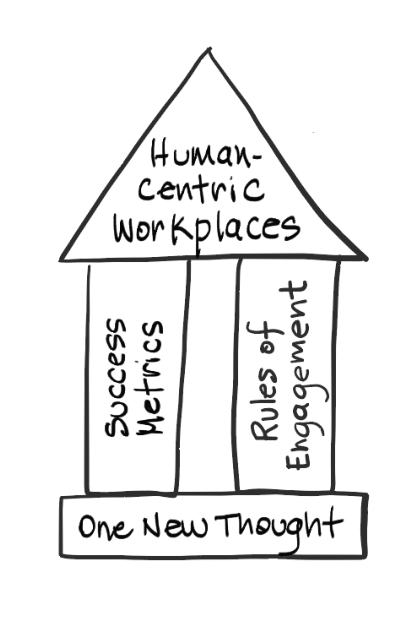
This is one of the reasons I developed Human-Centric Leading (HCL): to help us unlearn inherited mindsets and structures and better align what we seek to achieve with how we achieve it.
Two pillars that help are success metrics and rules of engagement: the first tells us how we'll measure progress toward our goals and the second, how we'll collaborate to accomplish them.
Underneath both is a new way of seeing ourselves and others. We’ll call it the One New Thought. While we're often treated as inputs or cogs within our inherited work structures, we come to recognize we’re whole beings with inherent value, emotional needs, and unlimited potential. This shift changes the goals and success metrics we choose and how we work together. The what and how can then support instead of undermine each other.
When the How Strengthens the What
Consider nurse Jos de Blok. He founded Buurtzorg, a Dutch home-care organization, in response to his frustration with voluminous administrative requirements and fragmented patient care. He designed the organization differently: nurses worked in small, self-managed teams with greater autonomy in patient care, less management, and fewer administrative requirements.
The goal was still excellent patient care, but the how was deliberately shaped to support it.
Research referenced in Reclaiming Our Humanity in the Workplace found that Buurtzorg nurses reported higher job satisfaction and empowerment, while patient satisfaction exceeded 90%. The organization also operated at lower costs than traditional providers.
By removing constraints that got in the way of patient care, nurses could use their knowledge and experience, solve problems and contribute their best in each situation. They also had greater opportunities to learn from each other, which can make work more enriching and meaningful.
Aligning the what and how isn't a one-and-done exercise. We need to keep looking at their outcomes and adjust them as conditions change.
What Aren't Your Metrics Telling You?
Success metrics matter.
In this article, we’ve explored three things to watch:
1) What happens when we maximize success metrics
2) Whether we're mistaking meeting the metric for achieving the goal
3) How pursuing our metrics affects trust, discernment, learning, creativity and other things we value
Bella's team was making more calls while their patients were doing worse. They were meeting the metric but missing the goal.
Want a Next Step?
Don't just ask, “Are we hitting our numbers?”
Ask whether the numbers are actually serving your goals, which behaviors and outcomes they're producing, and what rules you’re using to guide how you pursue them.
Explore more: What If Workplace Problems Aren’t People Problems? (#1); Do You Inadvertently Treat People Like They’re Replaceable? (#2); Recently-published book: Reclaiming Our Humanity in the Workplace.
Download the original article (PDF)