
Are You Ignoring Data That’s Hiding in Plain Sight?
To achieve success within our existing organizations, we collect enormous amounts of data. We track revenue, budgets, funding, costs, productivity, customer/client satisfaction, employee/citizen engagement, turnover, efficiency and other metrics. We use that data to understand what’s happening, spot problems, identify opportunities, and make better decisions. When we’re overloaded by it we turn to AI for help.
Yet despite all this data, many workplace problems persist. Distrust, disengagement, moral injury, conflict, talent and customer turnover and low levels of collaboration, creativity and proactivity are intensifying. We introduce new initiatives, processes, incentives, training and technologies, yet the same issues resurface.
Something else is happening as these issues arise.
We feel uneasy about a decision but can’t explain why. We become defensive when our ideas are questioned. We feel frustrated when we experience the same problem over and over. We become nervous about saying what we really think. Under stress, we react in ways that perpetuate the very problems we’re trying to solve.
What if those emotions are data that help us understand what’s really going on?
Our Workplaces Drain Our Humanity
If we draw out the basic structure of most of our workplaces, we’ll see variations of this:
The Magnificent Compression Machine represents the basic structure we’ve inherited. Efficiency and money (profits, budgets or funding) are maximized and prioritized. Power-over hierarchies assume that some people are more important than others. Labels reduce us into categories such as “innovative” or “difficult,” as if that’s all we are. Rewards and punishment, along with criticizing, judging and blaming, are used in the name of discouraging mistakes and encouraging excellence. Underneath it all is the assumption that we humans are only as good as what we can do. As a result, this system generates a slew of unwanted results including compliance, unnecessary mistakes, costly miscommunication, difficulty anticipating disruption, and a lack of flexibility, among other things.
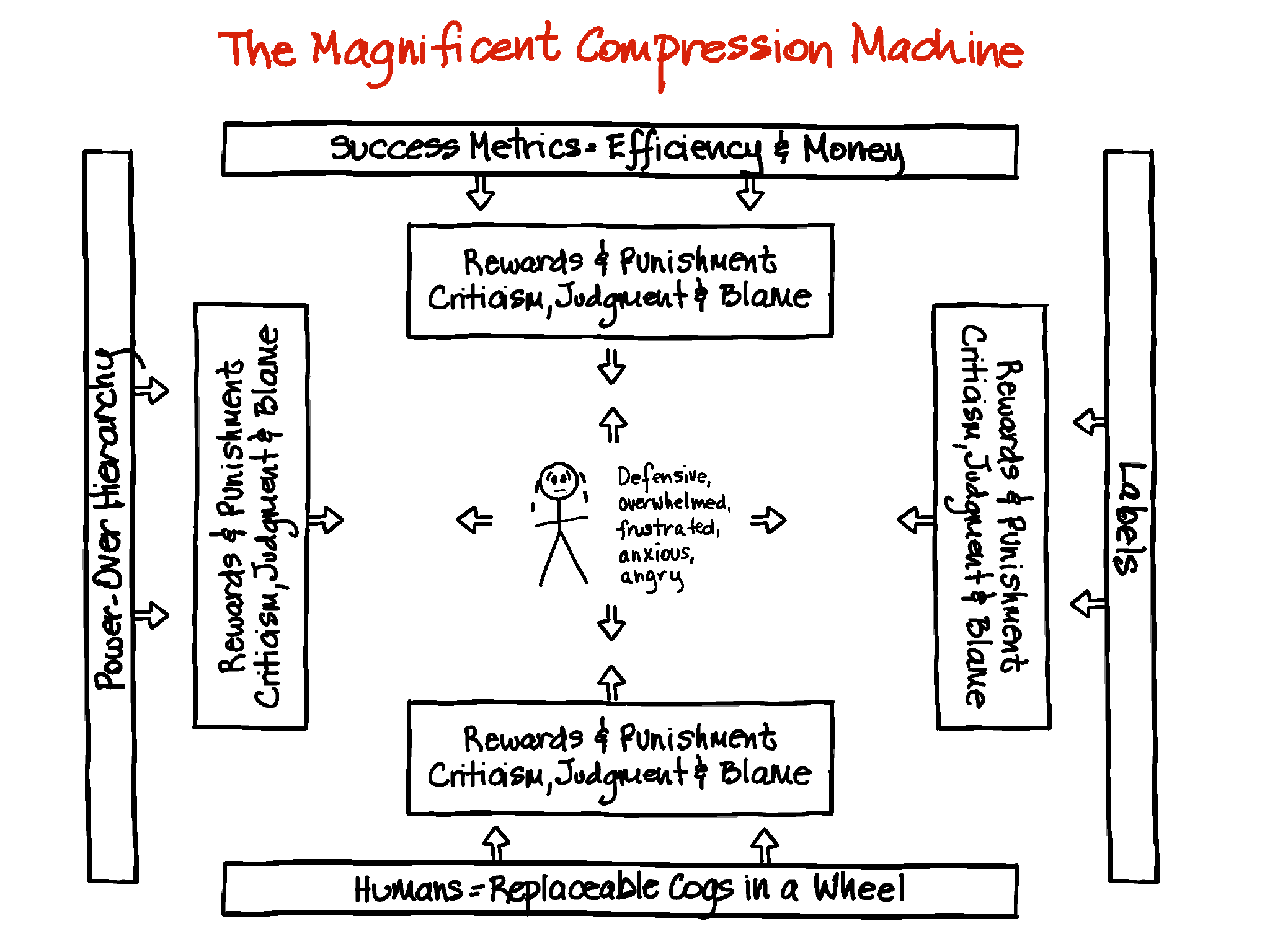
We’ve spent decades trying to improve this structure. We make it more efficient, advance technologies, develop leaders, and introduce new ways of managing people. Yet many of the unwanted behaviors and outcomes we’re trying to eliminate keep resurfacing.
So what’s happening?
We’re seen as inputs, workers, doers, costs or resources and expected to maximize our efficiency. That activates our survival instinct and pivots us into self-preservation mode. We worry about our livelihoods and focus on protecting our status and jobs, which often makes us defensive and reactive. This drains our capacity because energy and attention that could go toward work are instead spent protecting ourselves, managing our reactions and trying to hide what we feel. We’re then asked to be calm, creative, collaborative and innovative while also expected to stay rational and objective, leaving our emotions at the door.
This creates a double bind: our inherited workplaces activate uncomfortable emotions while expecting us to suppress them. If we express or acknowledge them, we risk being judged as “emotional” or unprofessional. If we ignore them, we risk undermining our ability to be empathic, creative, collaborative and resilient, which are often expected at work.
Emotions Don’t Disappear
Trying to keep emotions out of sight doesn’t prevent them from influencing us. Anger can show up as a curt reaction when someone criticizes our hard-earned promotion. Frustration can emerge as a jab at a colleague. Anxiety can influence a decision even when nobody knows we’re anxious.
The emotions themselves aren’t the problem. Problems arise when we react without understanding what’s driving us.
The good thing is that emotions have a logic. They arise in face of real or perceived threats or opportunities related to our survival and thriving. They don’t show up randomly.
Consider Zach. He was an inexperienced leader who joined an agricultural cooperative through a program for newly graduated MBAs. Participants rotated through three-year assignments designed to foster innovation. He was assigned to lead a team of experienced engineers.
On his first day, while standing at a podium talking with the team for the first time, Zach noticed a photograph of the organization’s top leader on the floor, defaced with a cartoonish mustache and horns. Annoyed, he asked who had done it. A senior team member from the back shouted, “That’s your fault.”
Zach froze. How could it be his fault when he'd just joined the organization? He’d already felt insecure about leading senior staff when he knew little, from experience, about leadership or innovation.
He remembered being taught that emotions come up for a reason. Instead of becoming defensive, he stepped down from the podium and asked, “OK. Something happened before I got here. What happened?”
That question opened up the conversation. Team members described years of frustration, anger and resentment as their once-egalitarian culture had become more hierarchical. Newly-graduated MBAs cycled through as presumed change-makers, while experienced engineers who had contributed to countless projects saw little improvement in their working conditions or promotion opportunities. They also said that the so-called “innovative” projects were designed more to impress than to create lasting value.
Zach listened. Rather than defending himself or the leadership program, he acknowledged what he was hearing and asked, “Knowing the context we’re in, what can I do to support you during my time here?” That shifted the conversation again and became the beginning of a different relationship with the team, allowing them to collaborate on how to move forward.
Their anger, frustration and resentment were data. They pointed Zach toward unfair conditions he couldn’t have known before he walked into the room. By staying curious, he was able to understand what was happening beneath the confrontation.
That’s how emotions can function as an internal GPS. They alert us that something deserves attention. The question is what we do with the information we access.
Human-Centric Leading is a mindset and toolset developed to help us unlearn the habit of pushing emotions aside. Instead, we recognize them as a key part of being human and a useful source of insight. The Emotions Tool helps us glean key information from emotions.
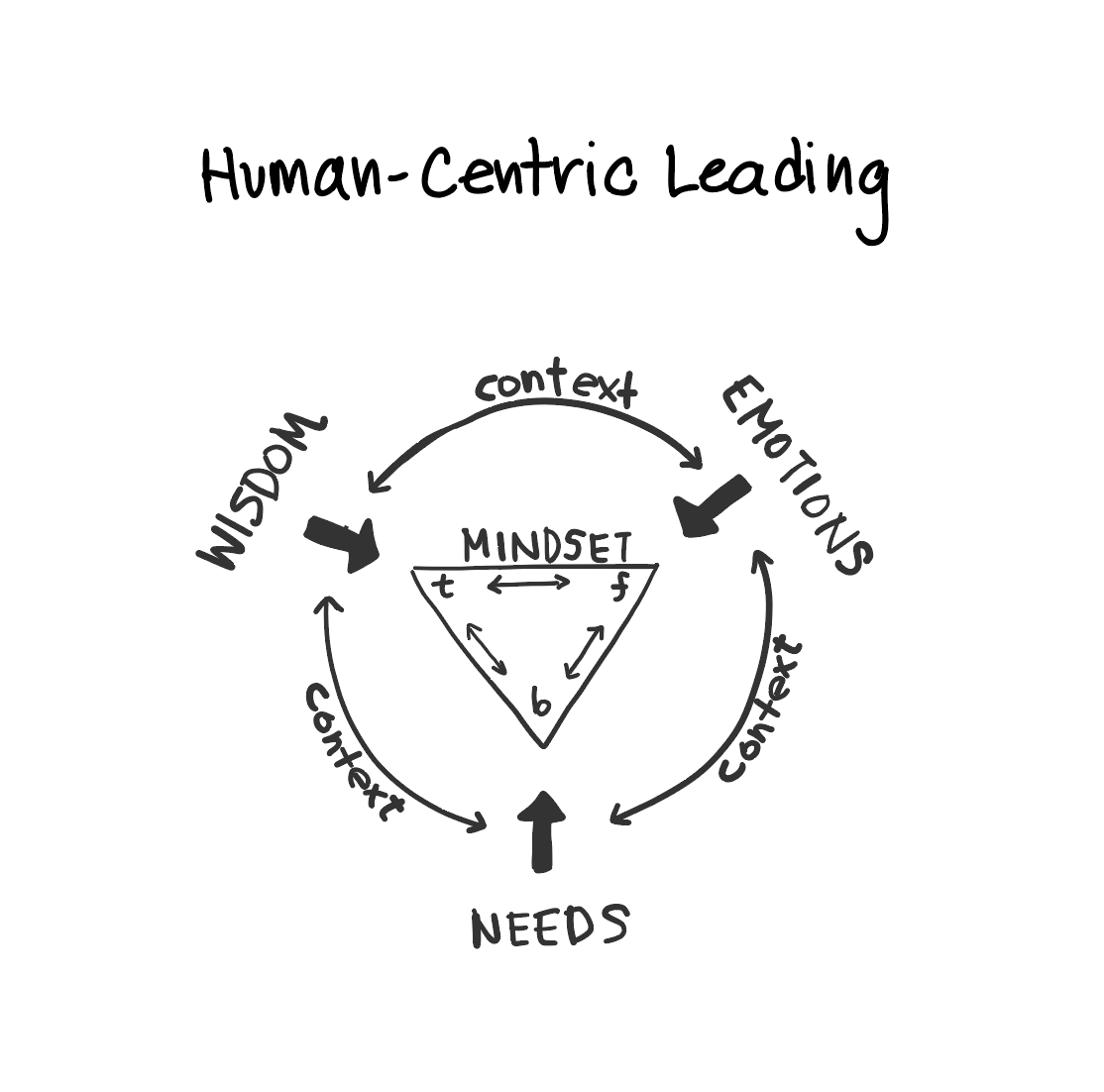
Emotions Are Data, Not Conclusions
Treating emotions as data doesn’t mean letting them drive our decisions.
If I feel threatened by a question you ask me, that doesn’t mean you were threatening me. If I feel angry about what you did, that doesn’t prove that you did something wrong. If a team feels frustrated by the disruption of their industry, that doesn’t mean the disruption isn’t a good wake-up call.
What we feel gives us something to investigate, not conclusions to accept as fact.
In our recently published book, Reclaiming Our Humanity in the Workplace, we offer three simple steps that help us pause and ask what we can learn from emotions:
Name it → Decode it → Respond to it
Name the emotion: What am I feeling? Naming the emotion reduces its intensity and gives us enough distance to observe what’s happening instead of being engulfed by it.
Decode the emotion: What’s the emotion telling me? What activated it? Psychologists have developed definitions we can use to better understand emotions in context. Instead of judging it, we can look for the reason(s) it surfaced.
Respond to the emotion’s insight: Given what I’ve learned about the emotion and what activated it, what will I choose to do now? I might raise a concern, ask a question, listen more carefully, examine one of my beliefs, change something in the environment, or decide that I need more information before doing anything at all.
Choosing how to respond is different from being reactive or “emotional.” Being reactive describes what we do: we think, feel, say or do something automatically, often driven by emotions. Being called “emotional” is different. It’s often used as a label and judgment that someone is being driven by emotion rather than reason, which can dismiss what they’re saying without examining whether their perspective is valid.
We can experience emotions, even intense ones, without becoming overwhelmed or engulfed in drama. We can still think clearly and choose how to respond.
What Emotions Help Us See
Consider George. He’s a leader in an innovation consulting firm whose team’s morale was slipping. He had recently learned about the connection between morale and emotions, so he asked his team a simple question:
“What are the top three emotions you regularly feel at work?”
He provided a list with definitions and created an online spreadsheet where they could respond anonymously. When he compiled the results, three rose to the top: anxiety, overwhelm and frustration.
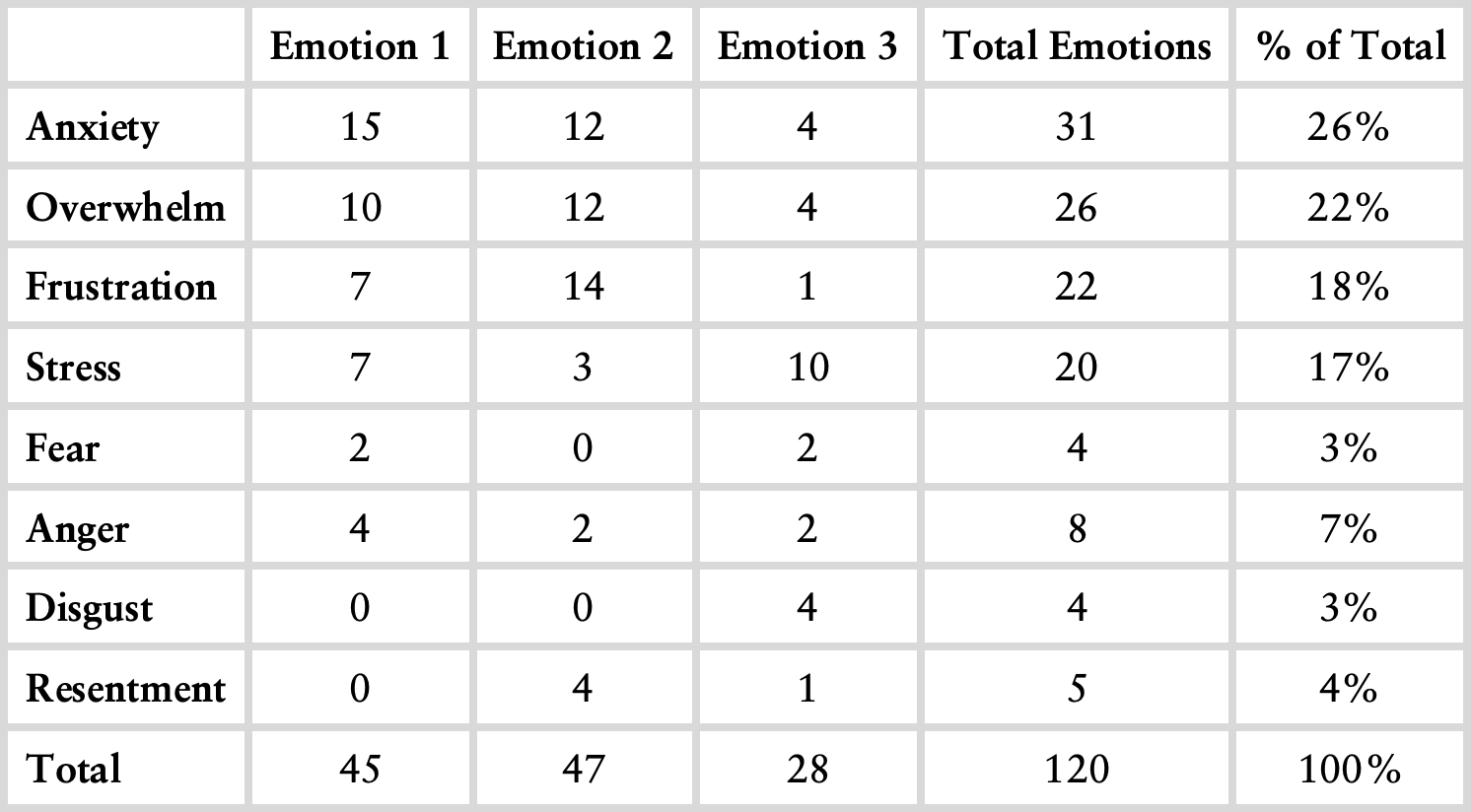
George now had data he hadn’t had before. It gave him clues about what was happening, but he still needed to understand what, specifically, was behind those emotions.
So he brought the team together for an offsite dinner and projected the results for everyone to see. He facilitated a discussion about what was behind their anxiety, overwhelm and frustration. Then, in small groups, they spent 30 minutes brainstorming what they could do about it. Each group shared their ideas while George captured them on the whiteboard.
The discussion moved quickly because the team already knew what was behind their emotions. They simply hadn’t turned that understanding into action.
Their anxiety was connected to losing an important client and fears about job security. Their overwhelm pointed to multitasking, too much work, unclear priorities and long, unpredictable hours. Their frustration came from working too fast to be creative, perfectionism, losing touch with the firm’s mission and the habit of accepting client changes without renegotiating scope, staffing, schedules or fees.
After reviewing their ideas, they prioritized three actions to take immediately. George continued tracking the team’s emotional patterns every week.
A month later, team members were more engaged, lighthearted and open. They examined why they had lost the client and what they needed to do to rebuild trust, turning what they’d learned into a client-relationship playbook and ultimately winning the client back.
What George learned went beyond what individual team members were feeling. When patterns of emotions show up across a team, they can point us to their working conditions.
Once we understand how those conditions are affecting us, we can begin changing what gets in the way of accessing our highest human capacities.
That moves us toward the Magnificent Inspiration Society:
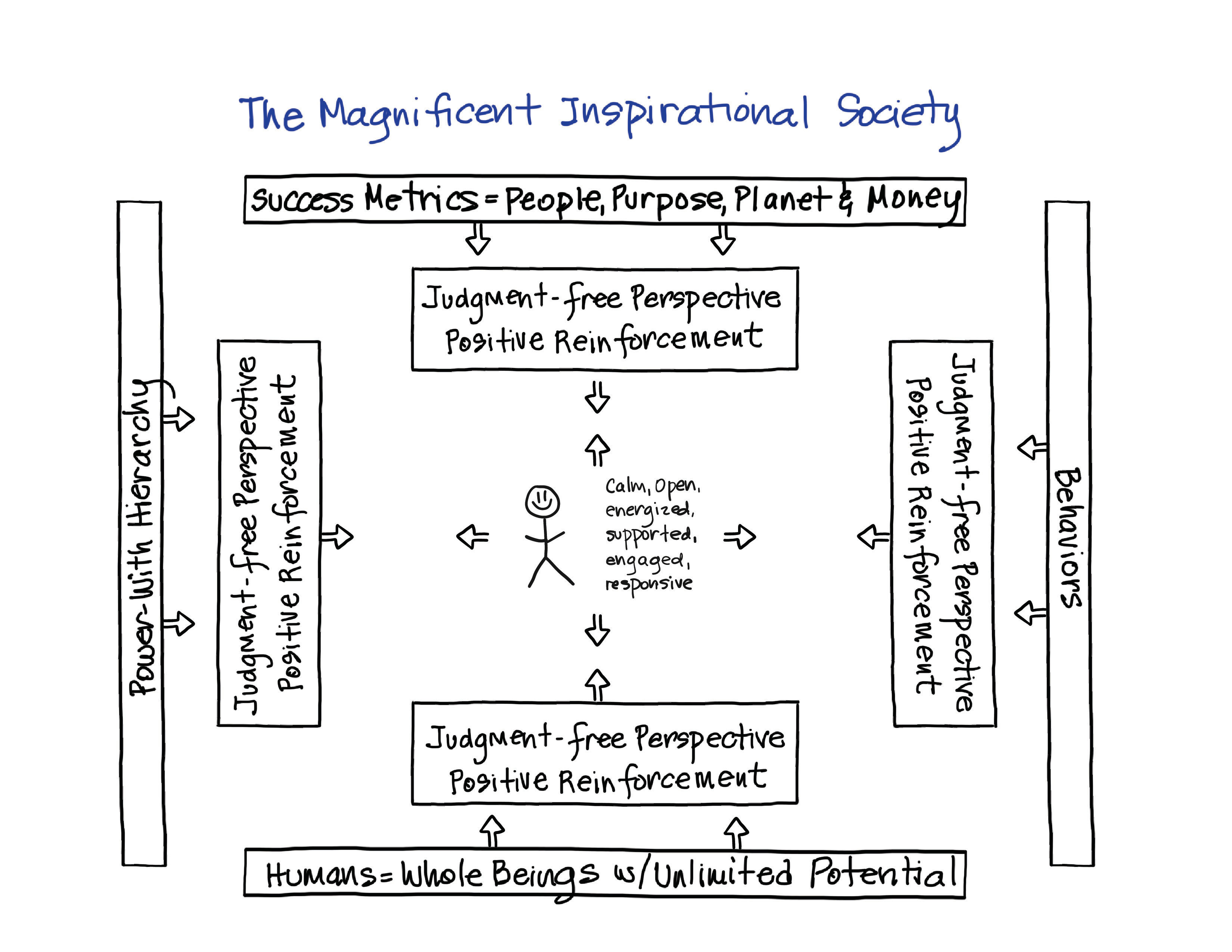
The Magnificent Inspiration Society represents an alternative to the Magnificent Compression Machine. Instead of perpetuating the workplaces we’ve inherited, we can intentionally create environments that help us work at our best and thrive.
Emotional data can inform that redesign. Joy, contentment, calm neutrality, relief and the like are data, too. They help us understand which situations support connection, meaning, confidence, creativity and engagement.
This brings us back to where we started: the conventional data we collect might tell us what’s happening.
Emotional data help us understand why.
Want a Next Step?
Try a small experiment.
The next time you experience an uncomfortable emotion at work, pause. Then:
Name it: What’s the emotion?
Decode it: What’s the emotion telling you? What brought it about?
Respond to it: Given what you now understand about the emotion’s meaning and what brought it about, what’s a wise next to take?
Learning to use emotions this way is part of what it means to reclaim our humanity in the workplace. As neuroscientist Antonio Damasio’s work has shown, emotion and reason work together in our thinking and decision-making. We’re human beings who think, feel, interpret, imagine, create, relate, adapt and choose.
The opportunity isn’t to make workplaces more emotional.
It’s to become wiser about how we use emotions at work.
Note: Data and information are used interchangeably in this article.
Explore more: What If Workplace Problems Aren’t People Problems? (#1); Do You Inadvertently Treat People Like They’re Replaceable? (#2); Are Your Success Metrics Getting in the Way of Success? (#3); Newly published book: Reclaiming Our Humanity in the Workplace.
Download the original article (PDF)